When I first moved to Tokyo, I knew very little about the city and genuinely didn’t know what to expect. Many years later, I now know much more about the city, but thankfully still never really know what to expect.
Culture
The clutter and grime of a Tokyo festival goldfish stall
Ban’ei, Hokkaido’s unique form of horse racing
Japan boasts a whole host of conventional racecourses, but Hokkaido’s Ban’ei Tokachi has just the one. With an origin in agricultural work, ban’ei involves huge draft horses pulling weights of up to a tonne along a 200 metre gravel track. An already arduous task that’s made all the more difficult by a couple of hill-shaped obstacles that slow proceedings down even further. In fact the race often comes to a standstill, as readjustments in direction are made, or the horses are braced before taking on the mounds — the sheer effort of which is hard to capture in a photo, especially from a distance, so for something of a taster, there’s a race video here.
This unusually slow pace also means that spectators can jog along at the side of the track to keep up with the race, although they are, somewhat half-heartedly, encouraged not to.
Starting out as an event at local festivals, the popularity of ban’ei grew to such an extent that in 1953, four racecourses were built. A business that eventually turned out to be unsustainable, and in 2007, the courses at Kitami, Asahikawa and Iwamizawa sadly closed down, leaving just the one at Obihiro.
Spending a good few hours there, it was interesting to see the number of punters ebb and flow. Visitors to the area clearly help enormously in keeping the enterprise viable, but like most forms of gambling, it has its hardcore fanbase. Old fellas mostly, who, like gamblers the world over, are there through thick and thin. Each and every time hoping, against all the odds, for that one last hurrah.
Tokyo festival faces and fatigue
Traditional Japanese festivals are always worth seeing as there’s a unique energy that makes each and every one of them enjoyable. But for those involved, the effort to create that dynamic can clearly be exhausting.
A Tokyo geisha
On an ordinary, nondescript Tokyo street, was a decidedly far from ordinary pedestrian.
I’d heard there were still some geisha in Tokyo, but I’d never seen one, and to be honest, never really expected to. Then turning a corner there she was, quickly making her way to an appointment. A wonderfully unusual moment that was almost as surreal as it was surprising.
Portrait of a Shinto shrine maiden
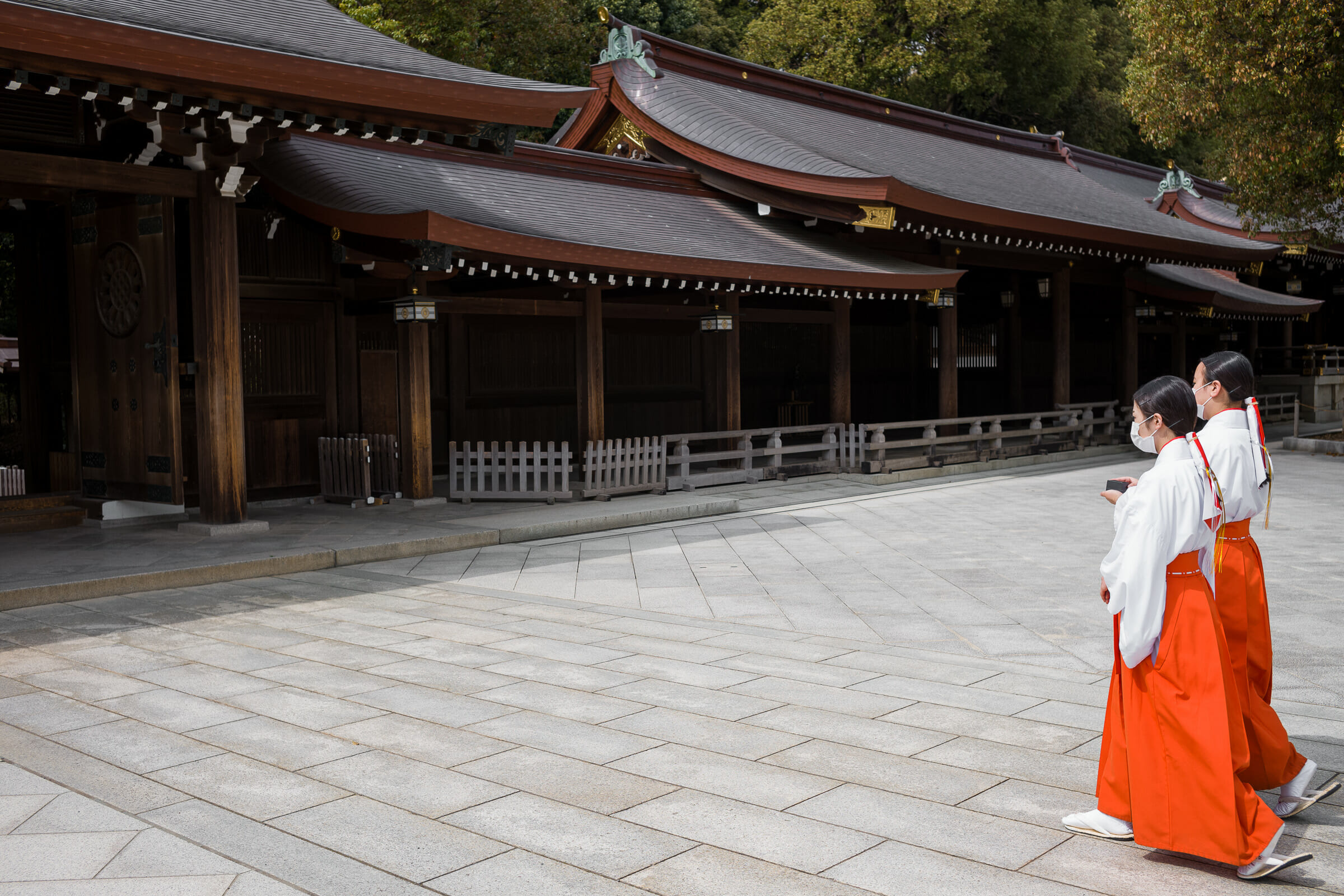
Miko, or Shinto shrine maidens, can often be seen selling amulets, taking part in ceremonies, or swiftly moving from one building to another. Young, identically dressed women who once had important roles within the religion, but nowadays are generally just University students helping out on a part-time basis.
Still, regardless of their status, or level of training, getting the chance for a quick portrait isn’t a common occurrence. At least not for me it isn’t, anyway. So here — in monochrome as it seemed best suited to the almost timeless nature of her position — is a rare photo of a Miko quietly going about her business.