• Skip to main content
  • Skip to footer

Tokyo Times

Photographs from a small group of islands

  • Photowalks
  • Portfolio
  • Book and Prints
  • Newsletter
  • About/Contact
  • Follow
    • Facebook
    • Instagram
    • Twitter
    • RSS

Culture

Jan 20 2005 6 Comments

Sumo sedition

The world of sumo is unsurprisingly a very traditional one. Wrestlers are expected to know their place in the sports strict hierarchy, and personal conduct is of the utmost importance.

Yet one sumo tradition that doesn’t always go down too well is that women are not allowed onto the dohyo (wrestling ring). Even during an award ceremony.

With sumo’s links to Shinto, the dohyo is considered sacred. Meaning wrestlers must throw salt onto the ring as an act of purification before they enter. And the problem this holds for women is that due to the bleeding associated with menstruation and childbirth, they are considered unclean.

But this being the 21st Century, such blatant discrimination is understandably frowned upon. Yet for sumo fans, the issue is far from clear-cut. Professor Yoshihiro Oinuma of Tokai University, polled 165 visitors about the problem at the 2004 November tournament. Of the respondents, 52% said they believed women should be allowed onto the dohyo during the award ceremony, whilst the remaining 48% disagreed.

In regards to the ban in general, 62% of fans felt that it should be maintained, whilst 52% said the issue should only be decided by sumo association officials. And in a grand gesture of indecisiveness, coupled with a large dollop of ambiguity, 75% said that generally speaking, they wanted to maintain groups that try to keep their own traditions.

Sumo stable master Takasago said, “I don’t think the results of the poll alone show a decisive trend.”

I think he may be right.

But judging by the picture below, perhaps those sticklers to tradition have a point after all.
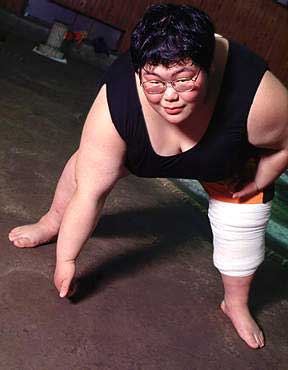
womens sumo

Categorized: Culture, Religion, Sports

Jan 12 2005 3 Comments

Fake food

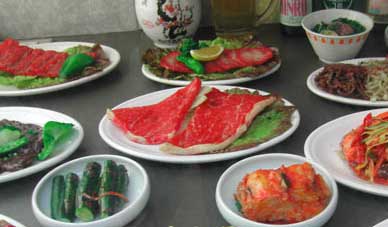
Many restaurants in Japan have plastic food displayed outside, showing off the (supposedly) fabulous dishes available inside. And whilst in some ways it’s a slightly odd practice, I won’t knock it, as if a menu turns out to be incomprehensible, there remains the last resort of escorting the waiter/waitress outside and pointing at the desired dish.

Now don’t laugh. I’ve done it. And on more than one occasion too. Although as you can imagine, it’s a tad embarrassing.

What I didn’t realize though, was that apart from being a gaijin safety net, these plastic foodstuffs are part of a multi-million yen industry. Apparently it all started 80 years ago in Gifu Prefecture, and current fake food masters get plenty of orders (and money) for their hand-crafted delights.

These artisans can conjure up lettuce with just a bit of green-coloured wax softened in hot water. And with some cheese and tomato coloured paste on a plastic pizza base, topped with a bit of airbrushing magic, they can produce a mouth-watering pizza.

Or alternatively, instead of going through all that trouble, a few pieces of garishly red plastic can simply be slapped on a plate and passed off as beef.

plastic japanese food

Although it has to be said that the lettuce underneath is a nice touch.

Categorized: Culture, Food and Drink

Jan 10 2005 1 Comment

Holiday homage

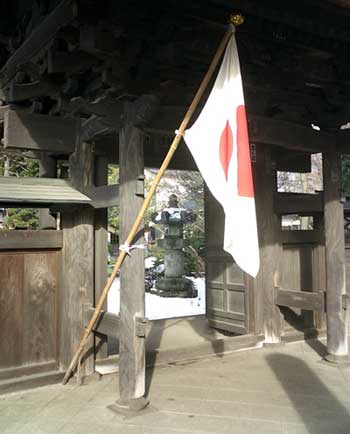
It’s fairly unusual to see the Japanese flag on public display. Except on national holidays. And seeing as today is such an occasion (Coming of Age Day), I suppose this picture is quite appropriate.

japanese flag

Although I must confess that I took this photo over the New Year holidays, and not today. Not that it makes the slightest difference of course, but I just thought I’d mention it.

Categorized: Culture, Photography

Jan 04 2005 Leave a Comment

Shinto shivers

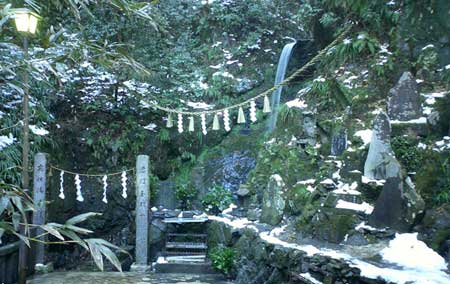
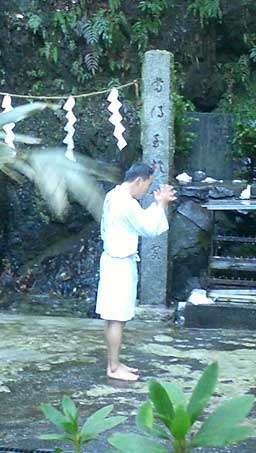
Today I was lucky enough to witness something I had previously only ever seen on TV. A man (presumably a Shinto Priest) praying underneath a waterfall.

Now whilst not the biggest waterfall in the world, as you can see from the picture below, there’s snow on the ground. Plus it’s situated halfway up a mountain, so I don’t need to stress how cold it must have been.

japanese waterfall

Unfortunately access was blocked and I couldn’t get very near. But having said that I guess it’s fair enough, as in the unlikely event of me trying something similar, I wouldn’t want a crowd.

Once under the water the hardy young man did a lot of shouting/praying. And after a few minutes (yes, it wasn’t a quick dash in and out) he emerged to gave a final and hearty Thank you very much to whichever god(s) he was praying to.

shinto priest

I would liked to have asked him how often he prays like this and how on earth he manages it, but he quickly darted off to a nearby building. Presumably to get himself dried off and warm. Or there again, perhaps to stick hot needles in his legs.

After what he’d just subjected himself to, who knows?

Categorized: Culture, Religion

Jan 03 2005 1 Comment

Deadly delicacy

Among the numerous special dishes eaten at New Year, one of them is a proven killer. And despite constant warnings (especially if you are eating alone), mochi always manages a few victims.

The food is a sticky rice cake with the emphasis on sticky, and the elderly are especially susceptible to chocking whilst eating it. In the Kanto region alone, 4 people died on New Year’s Day, plus 25 others were taken to hospital. With 15 of them falling into a critical condition.

Not the best of starts to the New Year it has to be said.

Categorized: Culture, Food and Drink

« Previous Page
Next Page »

Footer

Copyright © 2026 · Tokyo Times