• Skip to main content
  • Skip to footer

Tokyo Times

Photographs from a small group of islands

  • Photowalks
  • Portfolio
  • Book and Prints
  • Newsletter
  • About/Contact
  • Follow
    • Facebook
    • Instagram
    • Twitter
    • RSS

Current Affairs

Oct 14 2004 4 Comments

English elimination

The National Institute for Japanese Language (NIJL) is on the warpath. After its third meeting in an ongoing campaign, the organization is seeking to eliminate another 32 English words or phrases that have been deemed a standard part of daily Japanese. Providing this latest grouping is accepted, it will bring the total number of purged words to 141.

Now personally (and for obvious reasons) I’m more than happy to have English words used in everyday conversation. The more the merrier is my motto. But at the same time I can understand the NIJL’s concerns, especially as many of the words could presumably be just as easily said in Japanese. A few from the latest batch are, solution, mission, literacy, and initiative. I certainly couldn’t imagine imported Japanese words being used for similar examples in English.

But in its quest to limit the number of borrowed words, the NIJL is in danger of going a little too far. Some other examples up for elimination — and that are said to be a part of daily Japanese — are hazard map, road pricing, and my personal favourite, bottleneck manpower. Yes, bottleneck manpower! Is that a real word (or phrase) in any language, let alone one used in everyday conversation?

Perhaps of greater concern however is the NIJL’s process for selecting these words and phrases. It is rather worryingly based upon the comprehension of those aged 60 and over. If a word is misunderstood by at least a third of those canvassed, it is deemed worthy of inclusion. That’s it.

My fear concerning this it-has-to-be-understood-by-seniors approach is that other groups may latch on to the process, and before we know it, VCR’s, text messages, and video games could all become a thing of the past. Heck, if my father is a good indicator of his generation, then the internet, DVD’s, and even washing machines could also become purging potential.

Luddites rejoice!
Categorized: Current Affairs, Language, Technology Stuff

Sep 09 2004 3 Comments

All work and no play…

“I work from 8 a.m. to midnight every day. My overtime is 300 hours each month, and I can take only one holiday in six months.”

Bank employee, 34, in a telephone call to the Japan Association of Labor Lawyers, as unpaid overtime complaints rise.

Admittedly this is an extreme case, but from what I’ve seen myself, unpaid overtime is very common and generally unchallenged. Plus with the economy still in a slump, and the Japanese tradition of a job for life becoming a thing of the past, it isn’t going to go away any time soon.

Now whilst I haven’t really suffered culture shock in my time here, experiencing the Japanese attitude to work is certainly a shock of sorts. With this working for free business being a prime example. Coming from Britain, overtime itself is a dirty word. As for unpaid overtime, well…

Categorized: Culture, Current Affairs, General, Odd

Jun 09 2004 Leave a Comment

Ministerial mutterings

The whole nation was rocked last week by the brutal murder of an elementary school student by her classmate. Having led her friend into an unused room, the young killer sat her victim down, slashed her throat, and then left her to bleed to death.

But as if this wasn’t bad enough, Finance Minister Sadakazu Tanigaki has decided to inexplicably step into the fray after another cabinet minister, Kiichi Inoue, declared that the murder was indicative of how women had become more lively participants in Japanese society.

Obviously not content with the damage Inoue had already done, Tanigaki claimed that, “When I was young arson was a women’s crime. Men did it too, but it was pretty much a girly crime. Women would use paper cutters to slash throats, but that was overwhelmingly a crime committed by adult men.”

And when questioned about Inoue’s earlier comments, Tanigaki said, “It would have been unthinkable in the past for an elementary schoolgirl to have done something like this. Society, children, relations between the sexes all change. I don’t know whether it was all right to say something like ‘women have gotten stronger,’ but I guess he [Inoue] was trying to say something along the lines of how much society has changed.”

How such people manage to get through their day-to-day existence is something to wonder in itself, but how they manage to attain positions of real power is simply frightening.

Categorized: Current Affairs, General

Jun 02 2004 Leave a Comment

Peer-to-peersecution

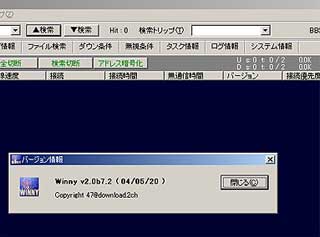
On Monday, the Kyoto District Prosecution Office filed charges against Mr. Isamu Kaneko. And seeing as he’s the man who developed Winny, the nation’s most widely used piece of file sharing software, the case could have a profound effect on how the whole file sharing issue is dealt with in Japan.

Kaneko-san released Winny for public use in April 2002, with the software designed to provide greater anonymity than that of WinMX. Which up until then had been the most popular piece of file sharing software in use.

When he was arrested last month, Kaneko (who is an assistant researcher at Tokyo University) was quite philosophical. As he commented that, “Basically, what I did clashes with the law, so it was almost inevitable that I was going to be arrested.” But now that he has been officially charged, the academic has understandably changed his stance somewhat. Both he and his lawyers are maintaining that he has no connection with users of the software, and in that sense his actions do not constitute supporting illegal file sharing.

winny01.jpg

The fact however that one 19-year-old user of Winny has already been prosecuted for downloading games and films doesn’t bode well for Kaneko’s chances. And prosecutors are also claiming that Kaneko produced numerous updates for the program, despite knowing that it could be used illegally.

Yet perhaps Winny and its developer could well have steered clear of the courts but for a few incidents that occurred over the last year. In March, a virus swept through the program, and in doing so managed to pick up investigation records from a Kyoto Prefectural police officer’s computer. Eventually spreading them around the net. This isn’t the only case of such an occurrence, and as well as police records, some Self-Defense Force documents have now been seen by a much larger audience than they were originally intended for.

For such things to happen though, one has to presume that several police officers and at least one person from the Self-Defense Force had Winny installed on a machine they were using either at work, or for work. I wonder why? And what’s more, will they be prosecuted too if found guilty of downloading copyrighted material?

But like I said earlier, this case could have a huge impact on how file sharing is dealt with. And as a response, Japanese net users have already started collecting money to help Mr. Kaneko defend himself. Now that he has been officially charged, any such contributions could prove to be very helpful indeed.

Categorized: Current Affairs, General, Web/Tech

May 28 2004 1 Comment

Mildly amusing Japanese-English #10

Bar code

Quite often, borrowed English words turn up in the strangest of situations, many of them far removed from their original meaning. But the reworking of bar code is a stroke of genius, as it perfectly describes what in regular English is a plain old comb-over.

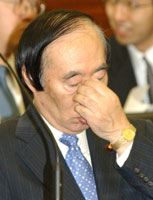
Sporting the bar code in the picture below is Japan’s Health, Labour, and Welfare Minister Chikara Sakaguchi. Another in the long line of Japanese politicians to have been caught missing payments to the national pension plan. But on the ever-growing list of non-payers, Mr. Sakaguchi is among distinguished friends. As Prime Minister Koizumi, and Tokyo’s obnoxious and racist Governor Shintaro Ishihara have also been found guilty of shirking their pension responsibilities.

But Sakaguchi-san may have got rumbled for not contributing fully to the pension fund, but judging by his impressive bar code, he still feels he can fool us into thinking he’s got a full head of hair.

bar_code.jpg

Are you going to tell him, or shall I?

Categorized: Current Affairs, General, Language

« Previous Page
Next Page »

Footer

Copyright © 2026 · Tokyo Times