In consumer crazy Japan, where shopping is a religion and brands are the new gods — what better name for a store than My Lord?
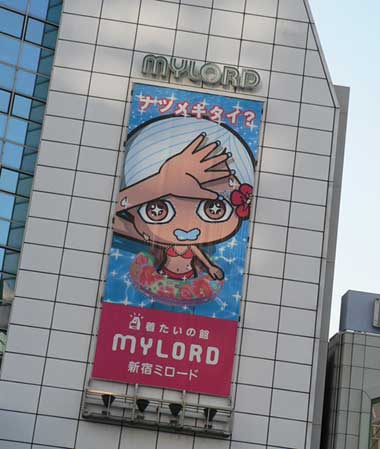
Apart from Vuitton or Prada of course.
Photographs from a small group of islands
In consumer crazy Japan, where shopping is a religion and brands are the new gods — what better name for a store than My Lord?
Apart from Vuitton or Prada of course.
There are classic cars, classic films, and even classic video games. Now, perhaps rather surprisingly, we can tentatively add underwear to the list; as after going out of fashion decades ago — and only kept alive by old men — the humble loincloth (fundoshi) is set to make a bottom baring comeback.
This most traditional of undergarments is now being sold in decidedly untraditional tartan and paisley patterns. Plus it’s also available in a wide range of colours and materials. Including silk for the more adventurous and extravagant fundoshi fan.
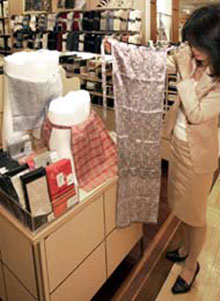
The expensive Mitsukoshi department store coined the term classic pants around 10 years ago, but it’s only recently that sales have started to take off. Pensioners may still be regular customers, but now young ladies are also joining them. Men’s clothing section manager Yoshimi Shuma claiming, “Women seem to be buying them for their boyfriends.†Yet salary men are also jumping on the fundoshi bandwagon, with many purchases made when good results are needed at work. The lowly loincloth being upgraded to power underwear. I kid you not.
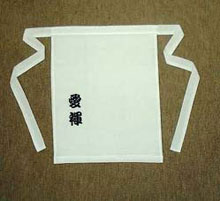
Loincloth expert and author of “Tales of Fundoshiâ€, Masatoki Minami, claims that the garment’s connection to militarism hastened its fall from grace. Yet western prudishness may also have played a part. Many foreign dignitaries that arrived in Japan during the Meiji Era (1868-1912) were appalled by the numerous labourers dressed only in their underwear. Complaining that the sight of barely concealed buttocks was far from appropriate.
All that’s in the past though, and it goes without saying that Minami-san is ecstatic about the revival of his favourite underwear; proudly claiming that, “some people consider the fundoshi to be cool.†The loincloth lover excitedly adding, “Japanese culture remains alive in that metre of cloth.â€
Which, if true, means that it’s only a matter of time before Hello Kitty loincloths hit the stores.
Wednesday saw the start of the government’s summer saving campaign, with bureaucrats and politicians being encouraged to dress casually in a bid reduce energy consumption. The relaxed dress code has rather optimistically been dubbed Cool Biz, and to mark the occasion, the nation’s wavy-haired Prime Minister ditched his jacket and tie for a relatively tasteful Okinawan shirt. Although the lack of neckwear must have been slightly distressing for Mr. Koizumi, as he appears to have made up for its absence with a rather large and gaudy rosette.
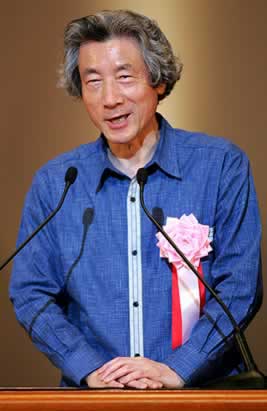
Despite the Prime Minister leading the way, not everyone was ready to ditch the tried and trusted shirt and tie. One bureaucrat from the Health, Labour and Welfare Ministry showed a distinct lack of initiative by saying, “We haven’t received any specific orders from our bosses. Today is the day when we are supposed to change to summer wear, so I want to decide later (whether to go without a jacket and tie) while looking at what my colleagues do.” With another man from the same department grumbling, “It cost more to buy clothes that look nice without a tie.â€
However such dull and unimaginative approaches to the new campaign appeared to have been shattered earlier in the day, when Foreign Minister Nobutaka Machimura said, “I’m surprised that my clothes have created such a stir.” Conjuring up images of the 61-year-old politician cutting a dash in a stylish Versace outfit. Or perhaps wowing young officials with a daring Vivienne Westwood design.
Yet sadly (and rather predictably) this wasn’t the case. Quite the opposite in fact. Machimura-san it turns out wore a lackluster blue business suit and a checkered shirt. A look — and the reaction to it — that says a great deal about the state of Japanese politics and the pedestrian approach to policy making.
From the beginning of next month, all government officials will be urged to dress casually in a bid to save energy. Cool Biz as it’s been dubbed, aims to save electricity by changing the ministry buildings air conditioning settings from a cool and comfortable 25-degrees, to a slightly more stuffy 28. With the shedding of ties and jackets intended to help bureaucrats and ministers stay comfortable in the warmer climate.
Chief Cabinet Secretary Hiroyuki Hosada is a keen supporter of the summer saving campaign, and told reporters that, “The important thing is to save energy by raising the temperature of air conditioning.” But not everyone is so enthusiastic. Veteran politician Toranosuke Katayama voiced concerns that, “It would be rather hot at 28-degrees.†Also adding, “There could be problems of dignity.â€
And right on cue, Hosada-san stepped out in this casual Okinawan top yesterday. Shirt and tie nestling stylishly underneath.
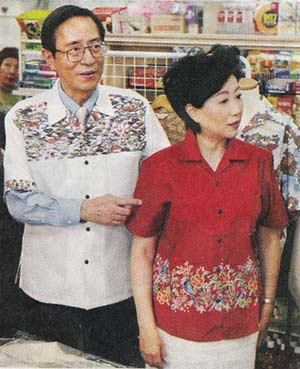
(Apologies for the low quality picture. I couldn’t find an online image, and had to scan the one posted from a newspaper. Thankfully though Hosada’s acute sense of fashion still shines through.)
With an early (but very strong) entry for the dullest and most pointless research project of the year, Bunka Women’s University professor Teruko Tamura studied the relationship between summer temperatures and the length of men’s sleeves.
In a report that must make for an absolutely riveting read, it was found that about 20 percent of men still wear long sleeves when the temperature exceeds 30 degrees. Women on the other hand are quick to adopt more suitable summer wear. Captivating stuff I think you’ll agree.
To acquire these frankly fascinating facts, Tamura-san and her team spent 10 days in June 2001 filming near Tokyo’s busy Shinjuku station. And from their footage they were able to check the clothing of 7,132 sweltering and sweaty men, and 3,699 cool and collected women. This sleeve-based information was then meticulously matched with temperature data from the Meteorological Agency.
Needless to say no life altering findings were uncovered, but Teruko “Temperature†Tamura did conclude that, “Men still seem to be bound by the custom to wear long sleeves even when it’s uncomfortable. Wearing long sleeves when the temperature goes above 25 is unpleasant and is bound to decrease productivity.”
So there you go. Research money very well spent.