Due to Japan’s ageing population and the continuing migration to the country’s large cities, it’s not really surprising that an increasing amount of houses are now left empty, or in many cases, completely abandoned. Yet the actual number of homes in such a state perhaps is. In 2008 — the last time such statistics were calculated — the figure stood at 7.57 million dwellings, or 13% of the total number of houses. A tally that is now estimated at somewhere in the region of 18%, and is expected to rise to a staggering 24% by 2028.
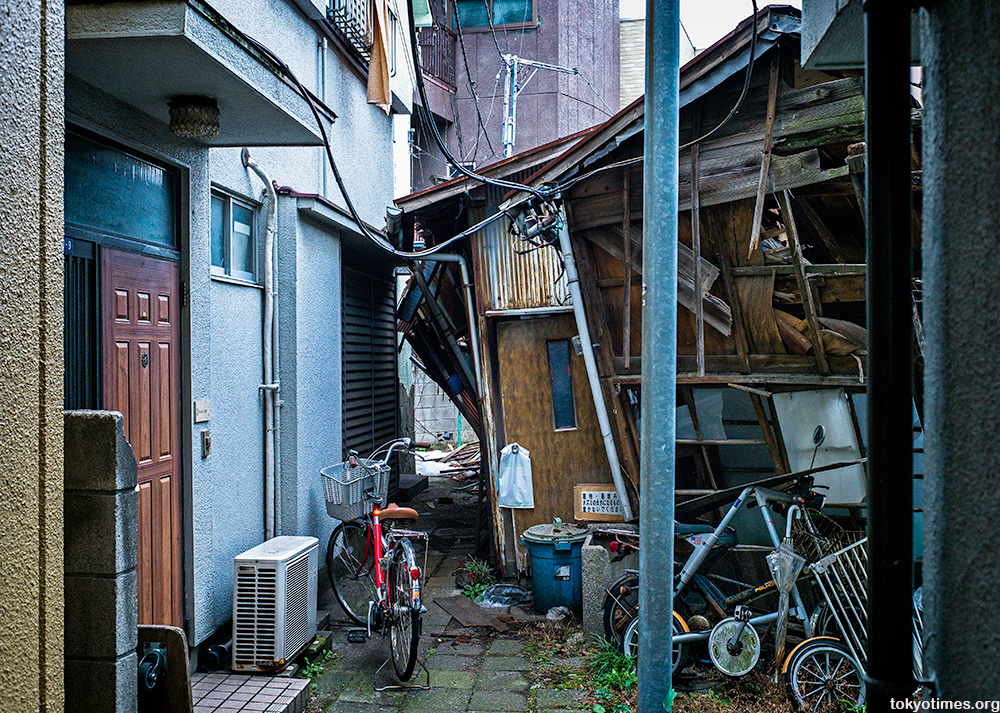
But such places aren’t merely restricted to less populated areas. Far from it. A combination of land/property tax incentives, plus a change in building regulations after the post-war period when many ageing wooden homes were constructed, means it’s financially beneficial to leave a property standing, regardless of its condition. Something that probably explains the number of crumbling, ramshackle houses one can regularly see in Tokyo — particularly in the city’s older neighbourhoods. None of the many I’ve seen, however, come close to the shocking state of this semi-collapsed monstrosity. A truly awful eyesore for the neighbours, not to mention a structural concern, as it’s clearly only the modern building that is keeping the old one (sort of) upright.