
Or shall we not bother?
Photographs from a small group of islands
Or shall we not bother?
With possibly the gimmick to end all gimmicks — at least in the world of alcohol production — an association of breweries in Kochi Prefecture have created the world’s first space sake.

Whilst sadly not clandestinely concocted on the International Space Station, the sake was however made with yeast that spent 10 days in space last year — aboard Russia’s Soyuz rocket. A move that is seen as a giant leap for manufacturers, with high hopes that it will help boost flagging sake sales; plus at the same time rather conveniently allow them to charge, ahem, out of this world prices.
News-starved residents of Tokyo are currently going crazy over the appearance of a ‘daikon’ (Japanese radish) in the city’s Higashikurume district, the robust root vegetable miraculously pushing its way through the asphalt by the side of a road.
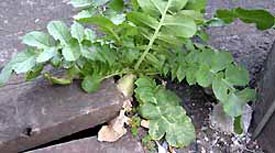
The radish’s emergence in an urban area without a hint of greenery has needless to say surprised many locals, with a Government official speaking for the majority by excitedly exclaiming, “I have no idea how the seed got here.†Yet sporting leaves that span the width of a human hand, and boasting a respectable diameter of 4 centimetres, the dynamic daikon can even be seen from the road, immeasurably brightening the morning trips of thousands of commuters.
This daikon dementia follows a similar incident in Aioi, Hyogo Prefecture, where an equally courageous radish recently appeared — local residents even going as far as naming it ‘Dokonjo Daikon’ (gutsy radish). A heartwarming tale that ultimately ended in tragedy, as a callous criminal sliced off the top of the vegetable; however its remains were rushed to a nearby agricultural research centre, where officials are still trying to bring it back to life. Town spokesman Jiro Matsuo tearfully stating, “People discouraged by tough times were cheered by its tenacity and strong will to live.â€
Yet if the unthinkable happens and the daikon dies, it will continue to live on, its story having been painstakingly immortilised in a 48-page book; a project in no way designed to cash in on the radish’s tragic story, with an Aioi Municipal Government official claiming that with ‘Ganbare Dai-chan’ (Hang in there, little daikon), “We want to reproduce the radish and add a new page to its history.” Author Ayumi Miyazaki, who laboured for a full two months to produce the masterpiece, also adding that she hopes the book will leave a lasting impression of the radish as it grew through the asphalt.

“While we were studying the whales, some onlookers said they looked appetizing. But I would not recommend eating them.”
University of Hokkaido lecturer, Tetsuya Endo, explaining the reaction of a few salivating scavengers as he examined a dozen or so melon-headed whales found dead in Chiba Prefecture; the researcher advising against consumption due to excessively high levels of mercury found in the beached mammals.
Now call me an unadventurous eater, or even a fool for passing up a free meal, but ‘appetizing’ isn’t exactly the first word that springs to mind when I see something like this.

The couple in the distance may or may not be cooking up a storm.
In an area where people mustn’t get out much, residents of Susami, Wakayama Prefecture, are currently going wild about an unusually shaped daikon (Japanese radish).
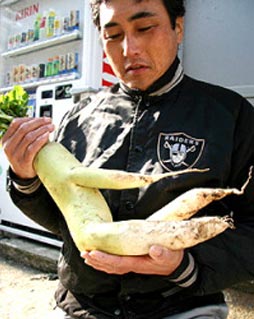
Found in the garden of 74-year-old Keiko Tanaka, this mildly interesting member of the mustard family is being likened in appearance to a woman crossing her legs. In fact, so uncanny is this resemblance, that locals have gone as far as naming the daikon ‘Monroe’; presumably after the famous movie icon and rumoured radish lover.
However whilst currently on display, the demure daikon’s time is almost up; as after eyeing up its luscious ‘legs’, Tanaka-san drooled to reporters, “I’m hoping that it will taste better than regular ones”. A comment that will surely dismay the entertainment starved residents of Susami.