• Skip to main content
  • Skip to footer

Tokyo Times

Photographs from a small group of islands

  • Photowalks
  • Portfolio
  • Book and Prints
  • Newsletter
  • About/Contact
  • Follow
    • Facebook
    • Instagram
    • Twitter
    • RSS

Language

Nov 22 2004 2 Comments

Mildly amusing English usage #5

Amongst most Japanese kids, foreign celebrities are arguably just as well known (if not more so) than their homegrown counterparts. As an example, just the merest hint of the word soccer invariably produces spontaneous and excited chants of “Beckham! Beckham!”

But all these foreign (and at times difficult to pronounce) names can get a little confusing. Or so it would seem after a class I had last week.

Practicing the riveting and overly used “What/Which _____ do you like?” I asked the class what sports they enjoyed. Thankfully one young student made the effort to answer, and he managed to blurt out that he’s a keen basketball fan. Deciding to abandon all caution and forge full steam ahead, I took the plunge and asked him which player he liked as a follow-up question.

Unfortunately this was the moment when the confusion arose and everything went pear shaped. Proud of his extensive basketball and NBA knowledge, the young fella excitedly told us that his favourite player is the one and only Michael Jackson!

Needless to say, after a brief pause to take in the magnitude of his mistake, we all guffawed loudly. Just long enough to make him cry and never want to study English ever again.

Ok, that last bit is not true, but his better-informed classmates found it hard to conceal their laughter. As it has to be said did their English teacher.

nba_jackson.jpg

Michael “NBA” Jackson yesterday giving a big thumbs-up after wowing fans with yet another flamboyant slam-dunk.
Categorized: Language, Music, Sports

Oct 31 2004 2 Comments

Rogues, rats and red lights

Shinjuku’s Kabukicho district is well known as a popular entertainment area. Although when I say entertainment, I don’t mean bingo halls and bowling alleys. No, it’s very much adult (and male) orientated. I always remember my first visit, as in the middle of the street was a man holding up a placard with an arrow pointing down — for want of a better description — a dark passageway. And on his advertising board in bold letters were the words ‘Anal Sex’. In English too. As a wide-eyed and naïve gaijin fresh off the boat, I was surprised to say the least.

Anyway, arriving in Shinjuku on Friday to meet a friend and finding myself a little early, I thought I’d take a little detour through this colourful part of town. But with it only being 4 pm, I wasn’t expecting to see much activity. I was wrong.

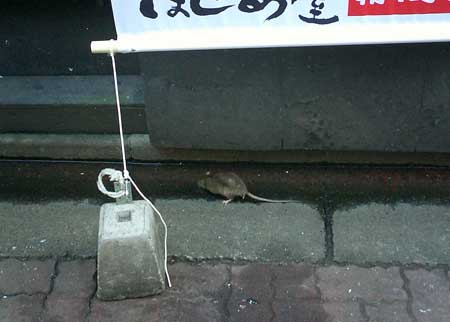
Within 3 minutes I’d seen a rat out on an early evening stroll, and been very kindly invited by numerous dodgy looking men in suits to watch a live show, have a sexy massage, or alternatively indulge in rigorous and fulfilling sex. Oh, and also the offer of a look around a shop that was selling all manner of unusual and exotic items. Many of which I couldn’t even begin to fathom their purpose.

rat02.jpg

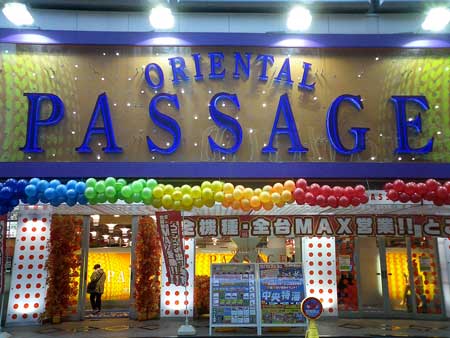
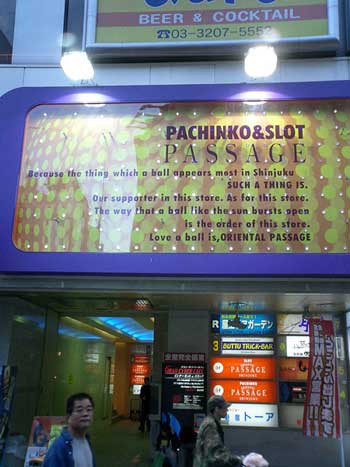
Although if those (apparent) sex aids were mind boggling, they weren’t quite as baffling as this sign above a nearby pachinko parlour.

strange_english.jpg

But considering the area it is situated in, and the various services on offer, the gambling emporium’s name is rather appropriate.

oriental_passage.jpg

Categorized: Culture, Language, Sex

Oct 25 2004 1 Comment

A grand day out

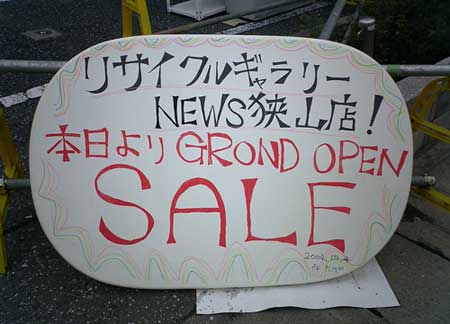
I came across a new shop the other week that was preparing to open its doors for the very first time. But the event was expected to be so big that it was beyond grand. Indeed, so spectacular were the plans that it was being billed as grond.

grond_open.jpg

Categorized: Language

Oct 20 2004 2 Comments

Dictator denied

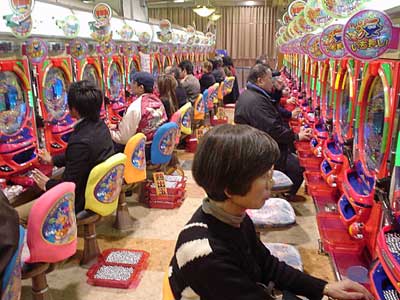
Pachinko is an unbelievably popular form of gambling in Japan. In the evenings and over the weekend, the rather glamorously named pachinko parlours are packed full of chain-smoking and coffee-glugging addicts. All sat transfixed in front of their flashing and noisy god of choice.

Pachinko01.jpg

To keep gamblers interested (and more importantly their wallets open), the machines are frequently updated and are sometimes named after famous characters, places, etc. But one pachinko machine maker has hit a stumbling block with a proposed list of names for its latest range.

The Japan Patent Office recently rejected a request by the company to register the names of 35 famous people. Unfortunately I don’t know the full list, but a couple of those mentioned were Moses and Hitler. Two very contrasting figures it has to be said. The specific reason for rejecting the use of the name Moses wasn’t revealed, but the application for Hitler was deemed inappropriate and a violation of the country’s pacifist constitution.

The manufacturer in question said it had intended to use the name of Hitler as a parody, but admitted to lacking discretion with its selection. What they had in mind for Moses was sadly not disclosed.

Categorized: Culture, Language, Odd

Oct 14 2004 4 Comments

English elimination

The National Institute for Japanese Language (NIJL) is on the warpath. After its third meeting in an ongoing campaign, the organization is seeking to eliminate another 32 English words or phrases that have been deemed a standard part of daily Japanese. Providing this latest grouping is accepted, it will bring the total number of purged words to 141.

Now personally (and for obvious reasons) I’m more than happy to have English words used in everyday conversation. The more the merrier is my motto. But at the same time I can understand the NIJL’s concerns, especially as many of the words could presumably be just as easily said in Japanese. A few from the latest batch are, solution, mission, literacy, and initiative. I certainly couldn’t imagine imported Japanese words being used for similar examples in English.

But in its quest to limit the number of borrowed words, the NIJL is in danger of going a little too far. Some other examples up for elimination — and that are said to be a part of daily Japanese — are hazard map, road pricing, and my personal favourite, bottleneck manpower. Yes, bottleneck manpower! Is that a real word (or phrase) in any language, let alone one used in everyday conversation?

Perhaps of greater concern however is the NIJL’s process for selecting these words and phrases. It is rather worryingly based upon the comprehension of those aged 60 and over. If a word is misunderstood by at least a third of those canvassed, it is deemed worthy of inclusion. That’s it.

My fear concerning this it-has-to-be-understood-by-seniors approach is that other groups may latch on to the process, and before we know it, VCR’s, text messages, and video games could all become a thing of the past. Heck, if my father is a good indicator of his generation, then the internet, DVD’s, and even washing machines could also become purging potential.

Luddites rejoice!

Categorized: Current Affairs, Language, Technology Stuff

« Previous Page
Next Page »

Footer

Copyright © 2026 · Tokyo Times