• Skip to main content
  • Skip to footer

Tokyo Times

Photographs from a small group of islands

  • Photowalks
  • Portfolio
  • Book and Prints
  • Newsletter
  • About/Contact
  • Follow
    • Facebook
    • Instagram
    • Twitter
    • RSS

Mar 17 2006 8 Comments

Discharge dilemma

This is possibly the last thing one wants to see when a bursting bladder is an issue — arguably even more so if any discharge discomfort is bowel related.
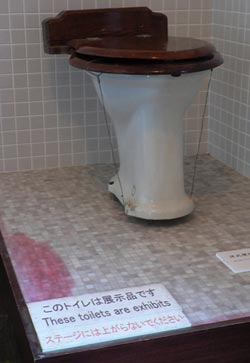
public toilet japan

Yet if the toilet is sealed at the bottom (which it was), and other people are as scarce as a functioning lavatory, do you risk ignoring the sign?

Or not?

Categorized: Photography

Mar 16 2006 1 Comment

Holy haul

Taking zero tolerance to extremes, a judge in Kobe sentenced a man to 22 months in prison on Tuesday — all for the theft of around 800 yen’s (4 pound) worth of goods, and a pathetically paltry 2 yen (tuppence ha’penny) from a shrine offertory box.

yen
half the haul

This harsh punishment is all the more shocking as unemployed Seiji Kondo took from June to October in 2005 to bag his 800 yen convenience store cache; some batteries and a few sundry items making up his pitiful plunder. Yet despite his lawyer’s pleas, the presiding judge was having none of it, the money stolen from the shrine costing the 27-year-old dearly: “Even 2 yen is part of the monetary offerings of shrine visitors. We cannot take what he did lightly despite the amount of money.”

The judge could perhaps also have gone on about how the Japanese justice system is successfully keeping undesirables like Kondo-san off the streets, yet considering that if the petty thief had raped somebody he’d potentially only serve an extra 2 months behind bars, it’s probably best he didn’t.

Categorized: General, Odd

Mar 15 2006 1 Comment

Cleaning clanger

Perhaps proving just how efficient its stain removal service is — and at the same time justifying the ‘plus’ boast — the dry cleaning shop below appears to have laundered this sign so much that the ‘e’ and ‘a’ have been completely eradicated.

engrish

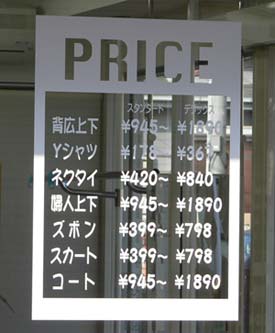
Rather embarrassing it has to be said, although such a simple spelling mistake is nothing compared to the potential pitfalls of a visit to such an establishment — at least for an unsuspecting non-native. Fresh off the boat at the time, but due to the summer humidity possessing less than fresh clothing, I valiantly ventured into a store offering similar services; the price list below displaying the very reasonable rates on offer.

Unfortunately I couldn’t read anything other than the prices, but the second option seemed fairly obvious, if a little unusual: ‘Yシャツ’ simply had to be ‘Y-fronts’ (briefs), the super low price of 178 yen appearing to confirm this. Thus, armed with a few shirts and a parcel of pungent pants, and pleased at avoiding a gruelling boil wash, I sheepishly handed over my cleaning.

The resultant awkward silence was excruciating — broken only briefly by a barely suppressed giggle from the lady behind me — until at last the crimson-faced woman in charge managed to explain that underpants were unacceptable, tentatively pushing the opened bag back in my direction. Frantic gestures and embarrassed pointing eventually revealing that ‘Yシャツ’ are actually shirts, and not the similarly (in my mind at least) named undergarments.

Presumably in fear of other unsuspecting foreigners presenting her with their pants, the poor lady had produced a helpful sign upon my return, displaying in no uncertain terms what was acceptable. And perhaps more importantly, what was not.*

*Large parts of this story may have been exaggerated or even entirely made up in order to get some mileage out of a rather dull picture of a misspelled sign. Alternatively, this could be a ploy by the writer to desperately disassociate himself with an unpleasant underpants related experience.

Categorized: Language, Photography, Underwear

Mar 14 2006 4 Comments

Gangsters’ paradise

After years of turning a blind eye, the Justice Ministry announced on Monday that from June 1, companies with ties to underworld syndicates will be prohibited from sponsoring foreigners entering Japan on entertainment visas; a decision aimed at restricting human-trafficking, with many of those on such visas forced to work in decidedly more nefarious forms of ‘entertainment’ than mere singing and dancing.

Honest, day-to-day money-making activities such as gambling, drug dealing and protection racketeering however will thankfully remained unaffected.

Categorized: Current Affairs, Sex

Mar 13 2006 6 Comments

Rogue radishes

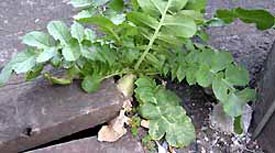
News-starved residents of Tokyo are currently going crazy over the appearance of a ‘daikon’ (Japanese radish) in the city’s Higashikurume district, the robust root vegetable miraculously pushing its way through the asphalt by the side of a road.

gutsy daikon

The radish’s emergence in an urban area without a hint of greenery has needless to say surprised many locals, with a Government official speaking for the majority by excitedly exclaiming, “I have no idea how the seed got here.” Yet sporting leaves that span the width of a human hand, and boasting a respectable diameter of 4 centimetres, the dynamic daikon can even be seen from the road, immeasurably brightening the morning trips of thousands of commuters.

This daikon dementia follows a similar incident in Aioi, Hyogo Prefecture, where an equally courageous radish recently appeared — local residents even going as far as naming it ‘Dokonjo Daikon’ (gutsy radish). A heartwarming tale that ultimately ended in tragedy, as a callous criminal sliced off the top of the vegetable; however its remains were rushed to a nearby agricultural research centre, where officials are still trying to bring it back to life. Town spokesman Jiro Matsuo tearfully stating, “People discouraged by tough times were cheered by its tenacity and strong will to live.”

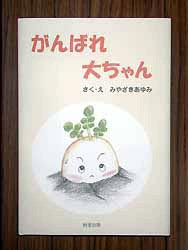
Yet if the unthinkable happens and the daikon dies, it will continue to live on, its story having been painstakingly immortilised in a 48-page book; a project in no way designed to cash in on the radish’s tragic story, with an Aioi Municipal Government official claiming that with ‘Ganbare Dai-chan’ (Hang in there, little daikon), “We want to reproduce the radish and add a new page to its history.” Author Ayumi Miyazaki, who laboured for a full two months to produce the masterpiece, also adding that she hopes the book will leave a lasting impression of the radish as it grew through the asphalt.

daikon book

Categorized: Books, Food and Drink, Odd

« Previous Page
Next Page »

Footer

Copyright © 2026 · Tokyo Times