• Skip to main content
  • Skip to footer

Tokyo Times

Photographs from a small group of islands

  • Photowalks
  • Portfolio
  • Book and Prints
  • Newsletter
  • About/Contact
  • Follow
    • Facebook
    • Instagram
    • Twitter
    • RSS

Oct 14 2004 4 Comments

English elimination

The National Institute for Japanese Language (NIJL) is on the warpath. After its third meeting in an ongoing campaign, the organization is seeking to eliminate another 32 English words or phrases that have been deemed a standard part of daily Japanese. Providing this latest grouping is accepted, it will bring the total number of purged words to 141.

Now personally (and for obvious reasons) I’m more than happy to have English words used in everyday conversation. The more the merrier is my motto. But at the same time I can understand the NIJL’s concerns, especially as many of the words could presumably be just as easily said in Japanese. A few from the latest batch are, solution, mission, literacy, and initiative. I certainly couldn’t imagine imported Japanese words being used for similar examples in English.

But in its quest to limit the number of borrowed words, the NIJL is in danger of going a little too far. Some other examples up for elimination — and that are said to be a part of daily Japanese — are hazard map, road pricing, and my personal favourite, bottleneck manpower. Yes, bottleneck manpower! Is that a real word (or phrase) in any language, let alone one used in everyday conversation?

Perhaps of greater concern however is the NIJL’s process for selecting these words and phrases. It is rather worryingly based upon the comprehension of those aged 60 and over. If a word is misunderstood by at least a third of those canvassed, it is deemed worthy of inclusion. That’s it.

My fear concerning this it-has-to-be-understood-by-seniors approach is that other groups may latch on to the process, and before we know it, VCR’s, text messages, and video games could all become a thing of the past. Heck, if my father is a good indicator of his generation, then the internet, DVD’s, and even washing machines could also become purging potential.

Luddites rejoice!

Categorized: Current Affairs, Language, Technology Stuff

Oct 13 2004 3 Comments

Daytime duel

Daytime Japanese TV isn’t exactly renowned for its interesting programmes or ingenuity, but recently the mind-numbing midday spot has been given a spark of life by a fearsome breast battle.

In the left corner, and representing TBS, we have Eri Furuse. Despite being a relative newcomer to national television, armed with her 95-centimetre bust, Furuse-san has quickly become a force to be reckoned with. Her nickname suikappu, which likens her mammeries to melons, says everything you need to know about her unquestionable talent(s).

eri_furuse.jpg

Over in the other corner we have Fuji TV’s Waka Inoue, who whilst slightly smaller than Suikappu, stills weighs in at an impressive 90-centimetres. And although behind in the size stakes, Inoue-san competes strongly in the nickname-alluding-to-breast-size contest. She commonly goes by the moniker Wakapai, which cleverly combines part of her name and the word oppai (breasts). Classy eh?

inoue_waka.jpg

This cleavage contest it is hoped will inject a bit of life into a scheduling time that is referred to as the Black Zone. But Suikappu and her melon-like breasts are feeling the pressure. Last month it was reported that TBS had a rather flat 2.1% of the ratings, whereas Fuji TV had a more impressive and curvy 9.3%. Even if Furuse-san manages to convert her extra centimetres to percentage points, Fuji TV is going to be hard act to beat.

Show-biz reporter Kouzou Inoue believes that breast size aside, the TBS star simply doesn’t have what it takes. “Waka Inoue is pretty popular among women as well as men, so she is good for daytime TV. Furuse is targeting businessmen, so she needs to act more like an anchorwoman instead of a ‘suikkappu’ idol,’ although I don’t think she is capable of reversing the audience rating.”

Rumours of the 2 presenters battling things out once and for all in a bikini-clad mud-wrestling contest have sadly yet to be confirmed.

Categorized: Sex, Television

Oct 12 2004 5 Comments

Heisei history

Whilst Japan follows the standard system of year, month, and day, the traditional practice of marking years in connection with current and past emperors is also used. This means that unless you are getting on in years (or alternatively are very young), your date of birth will fall somewhere in the Showa Era (1926-1989). The long reign of Japan’s controversial wartime head of state, Emperor Hirohito. So for me, I can say I was born in 1969, or if I want to impress any nearby Japanese, Showa 44.

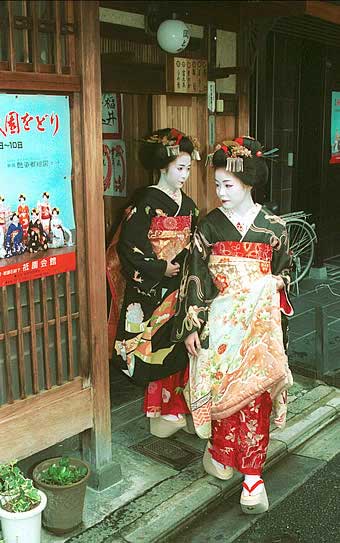
This is all well and good, but last week this method of marking time produced an historical event of sorts. The two maiko (apprentice geisha) pictured below, debuted with their very first rounds of Gion teahouses. The one on the left may make a name for herself by becoming a respected and skilled geisha, however young Fumiko on the right is assured of at least a footnote in the history books. As at the tender age of 15, she has become the very first maiko to be born in the current Heisei Era. A period that begun in 1989 with the death of Hirohito, and the ascendance to the throne of his son, Akihito.

maiko.jpg

Fascinating stuff eh?

Categorized: Culture

Oct 11 2004 1 Comment

Pop promoter

Michael Jackson’s profile here took a heavy beating when the controversial Martin Bashir interview finally got a Japanese screening. And the recent allegations and impending court case have further tarnished his battered image. But that doesn’t mean to say that everyone has deserted the self-styled Peter Pan of pop.

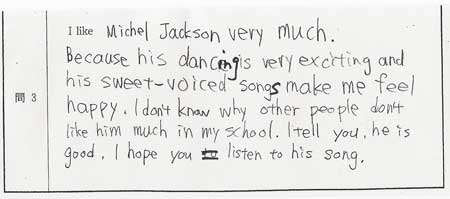
In a recent test, some students at my school were asked to write about something they like. Most students listed various sports, films, or video games. One even managed the unbelievably banal answer of apples. Yet the same question also prompted one young Jackson fan to vent his dismay at his idol’s treatment, whilst at the same time trying to bolster the singer’s tarnished image.

michael_jackson.jpg

Such devotion from a 13-year-old boy would surely bring a broad smile to Mr. Jackson’s somewhat ghoulish face.

Categorized: Music

Oct 09 2004 2 Comments

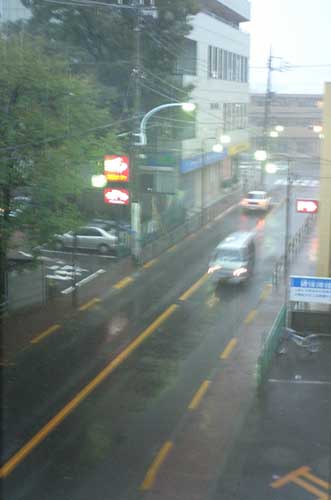
Typhoon cometh

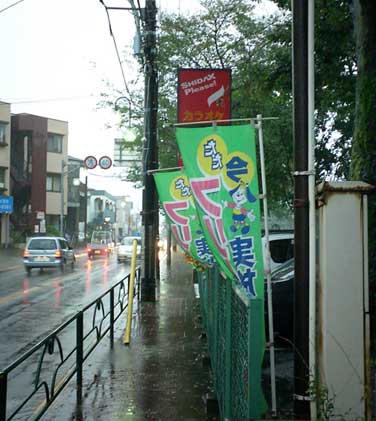
The 22nd typhoon of the year is expected to hit Tokyo and the surrounding area in a couple of hours (6pm). And experts are predicting it will be the strongest to hit the region in over a decade. By noon tomorrow, we have been told to expect about 250 millimetres of rainfall.

It’s not pleasant, that’s for sure.

typhoon.jpg

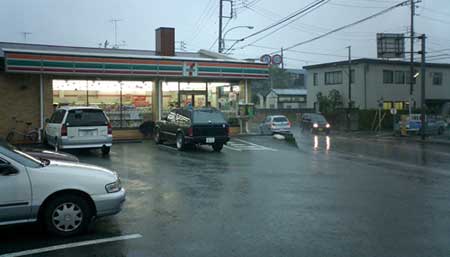
Although I am fortunate in that a (typhoon proof and licensed) convenience store lies around the corner from where I live. Just near enough to make a quick beverage dash.

convenience.jpg

[Edit]

It’s arrived. And just like the trains, it was on time.

typhoon02.jpg

Categorized: General

« Previous Page
Next Page »

Footer

Copyright © 2026 · Tokyo Times